Has life ever existed on Mars?
It’s unlikely that life exists on cold, arid Mars today. But what about in the past? Since the 1960s, space missions to the Red Planet have been trying to find out.
Bringing rocks from Mars back to Earth for study in state-of-the-art laboratories might finally solve the mystery.
This virtual exhibition explores the international Mars Sample Return campaign, a joint project between NASA and the European Space Agency (ESA).
Use the interactive 3D models to explore Mars, technology used to collect samples, and martian meteorites. If your phone or tablet is AR enabled, see how they look in your room, on your desk or in your hand!
Mars and Earth are very different today but there is evidence that, billions of years ago, they were much more alike.
Scientists think that oceans once covered the martian surface, and large quantities of water are still locked away as ice at the pole and in underground reservoirs.
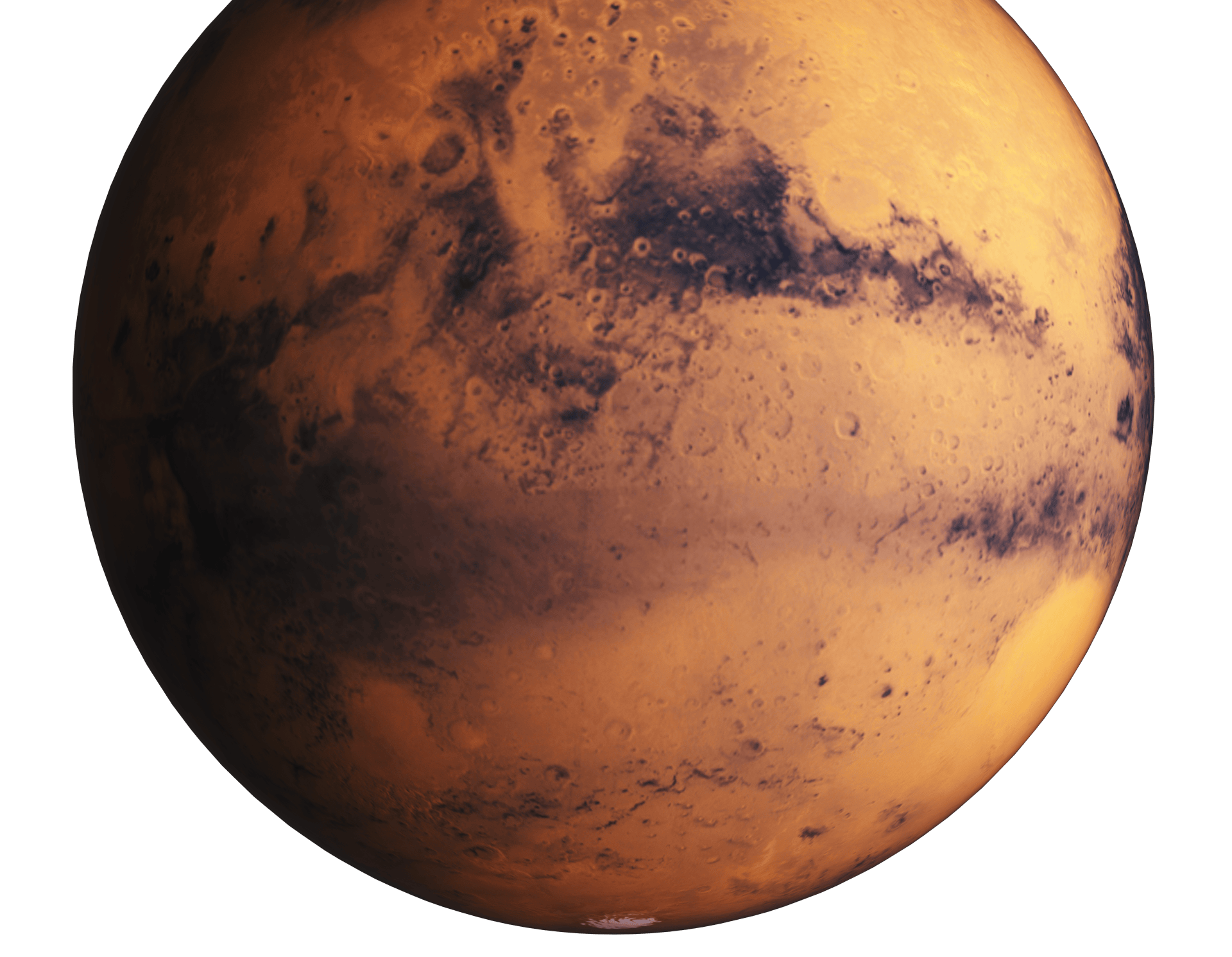
Click the download icon to start the 3D model of Mars revolving. Move it round and zoom in to see features.
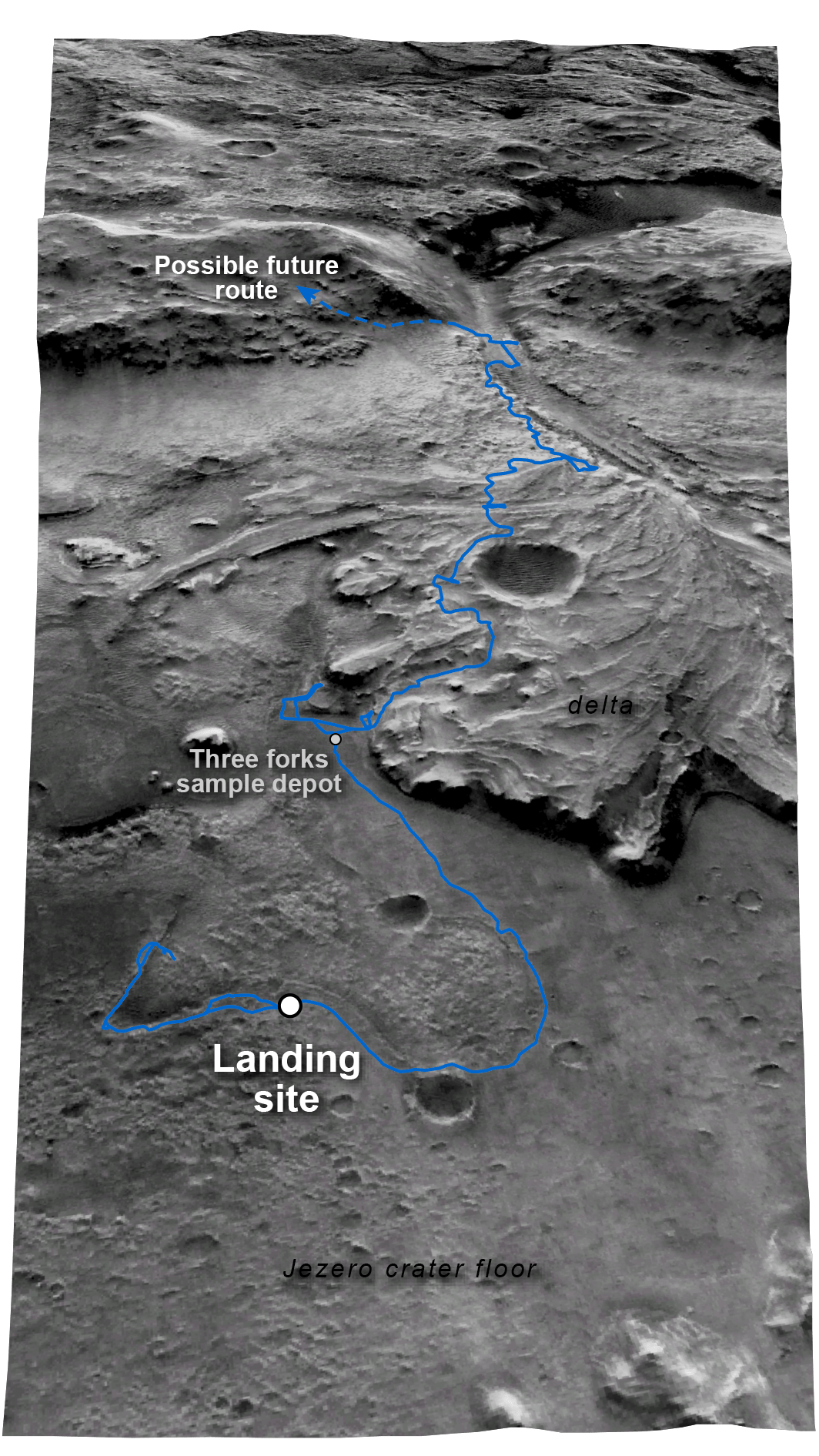
Jezero crater, the collection site for the Mars Sample Return campaign, is located north of the equator on the boundary between dark mountains and an impact basin.
Can you find:- Olympus Mons, the largest volcano in the Solar System
- Valles Marineris, the longest canyon in the Solar System
- The ice caps at the north and south poles
NASA’s Perseverance rover captured this portrait of its recently completed sample depot using its Mastcam-Z camera on Jan. 31, 2023, the 693rd Martian day, or sol, of the mission. Containing 10 samples, the depot is a crucial milestone in the NASA-ESA Mars Sample Return campaign.
Credit: NASA/JPL-Caltech/ASU/MSSS
A few rocks from Mars have already found their way to Earth. Martian meteorites are debris flung out by large impacts on Mars that have intercepted Earth’s orbit, landed on our planet and been found by meteorite hunters.
Chemical analysis of the minerals and pockets of gas trapped inside can be matched to martian conditions, proving the meteorites’ origin.
The Natural History Museum’s collection includes martian meteorites found in Africa, Asia and Europe.
Click the download icon to interact with the 3D model of the meteorite. Move it round and zoom in to see features.
Click on the chat icon to find out more about what you are looking at.
The Nakhla meteorite fell to Earth on June 28th, 1911, in the Alexandria region of Egypt. Multiple fragments were witnessed falling from the sky which is why the Nakhla meteorite is classified as a fall. Around 40 individual stones of Nakhla were recovered giving a total weight of 10 kilograms.
This piece of Nakhla is 141.6 grams. Nakhla is classified as a nakhlite meaning that it is mainly composed of the mineral augite. Nakhla also contains the mineral olivine and minerals that form in the presence of water. This meteorite has a thin black layer on its outer surface known as a fusion crust. This is as a result of melting on the meteorites outer surface as it fell through the Earth’s atmosphere. To see what Nakhla looks like under a microscope go to: either have link to virtual microscope (Nakhla 1 (virtualmicroscope.org)) or Natasha thin section image?.
Intriguing Martian rocks surround NASA’s Perseverance rover in this panorama showing an ancient river delta, made from images captured by the Mastcam-Z camera system. These images were taken in 2022 on June 12, 13, 16, 17, and 20 (the 466th, 467th, 470th, 471st, and 474th Martian days, or sols, of Perseverance’s mission)
Credit: NASA/JPL-Caltech/ASU/MSSS
The first stage in the Mars Sample return campaign is the collection of samples from Jezero Crater by NASA’s Perseverance Rover.
3 billion years ago, when Mars was warmer and wetter, Jezero Crater was filled by a deep lake. It would have been the kind of environment where, on Earth, life thrives.
Click the download icon to fly over the Jezero Crater. Perseverance has been exploring the central area of this tile.
With AR enabled devices, project it on the floor.
- The bed of the ancient river that flowed into Jezero Crater
- The delta of sediment deposited by the ancient river
- The Belva impact crater embedded in the delta.
- A W-shaped hill with a sloping back, where Perseverance landed.
If you want to experience more of the sights and sounds of Jezero Crater, visit the hiking map!
Perseverance's Selfie with Ingenuity: NASA’s Perseverance Mars rover took a selfie with the Ingenuity helicopter, seen here about 13 feet (3.9 meters) from the rover in this image.
Credit: NASA/JPL-Caltech/ASU/MSSS
Perseverance is the largest and heaviest rover ever sent to Mars. At around 2 meters high and 3 meters wide, the NASA rover is about the size of a small car.
Click the download icon to explore the Perseverance rover in 3D.
With AR enabled devices, project it on your desk or the floor. Zoom in to see instruments, or crawl underneath its belly.
Many people around the world are preparing for Mars Sample Return. Cutting-edge laboratory techniques will be used to study the rocks, and look for evidence of past environments, and even fossilised life, on Mars.
Mars-like places on Earth are also being used to test instruments and understand more about the samples and data Perseverance and Ingenuity have gathered on Mars
NASA’s Ingenuity Mars helicopter is seen here in a close-up taken by Mastcam-Z, a pair of zoomable cameras aboard the Perseverance rover. This image was taken on April 5, the 45th Martian day, or sol, of the mission.
Credit: NASA/JPL-Caltech/ASU/MSSS
Ingenuity’s main job was to demonstrate that helicopters could be used to explore Mars.
Since the martian atmosphere is much less dense than Earth’s, Ingenuity was designed with a mass of just 1.8 kilogrammes.
Click the download icon to explore the Ingenuity Helicopter in 3D. With AR enabled devices, see how the real-size Ingenuity fits into your home.
TThe precious samples of Mars brought to Earth will be housed in a specialised facility. Great care will be taken both to ensure that the martian samples are protected from terrestrial contamination and that they are safely contained until they have been analysed for any potential hazards.
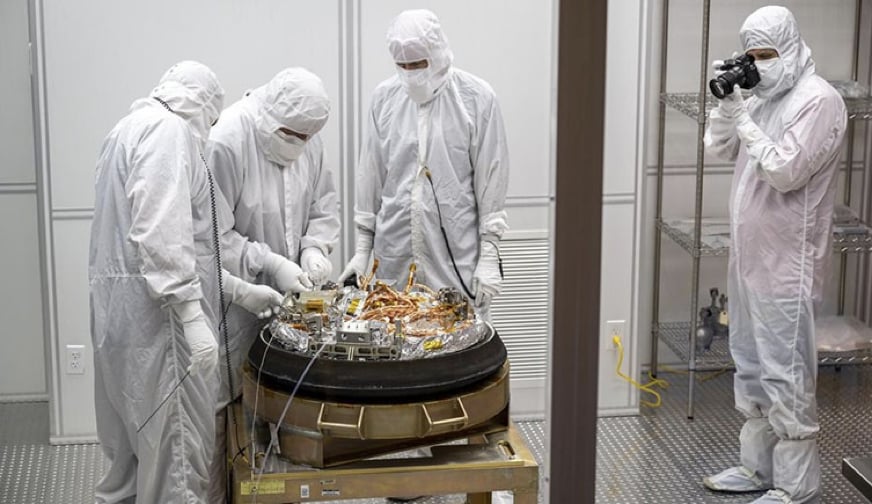
Click the download icon to interact with the 3D model of the sample tube. Move it round and zoom in to see features.
With AR enabled devices, see how the real-size sample tube fits into your home or classroom.
The actual sample tubes will hold around 15 grams of Mars rock, dust and atmospheric gas. The total amount of sample material to be returned will fit in a volume the size of a basketball.
About
This virtual exhibition aims to highlight the international collaboration behind the Mars Sample Return campaign.
The content has been developed by the Natural History Museum and partner institutions involved in the Europlanet 2024 RI project.
The main content is designed for the general public, but visitors can click through for more in-depth information. Further suggestions on using the content can be found through these links:
- For teachers, educators and outreach providers
- For undergraduate students and course leaders
Find out more about the deployment of the AR models here
Find out about AR-compatible devices:
https://www.arcade-xr.com/is-my-device-ar-compatible
https://developers.google.com/ar/devices
Credits:
Mars Planet texture by: Jet Propulsion Laboratory, California Institute of Technology
Main page parallax images: NASA/JPL-Caltech/MSSS
Perseverance & Ingenuity models: NASA/JPL-Caltech
Sample Tube model based on STL by: Jet Propulsion Laboratory, California Institute of Technology
Exhibition development: NHM, Europlanet.

Europlanet 2024 RI has received funding from the European Union's Horizon 2020 research and innovation programme under grant agreement No 871149.